THE AXANTHIC BLUEPRINT
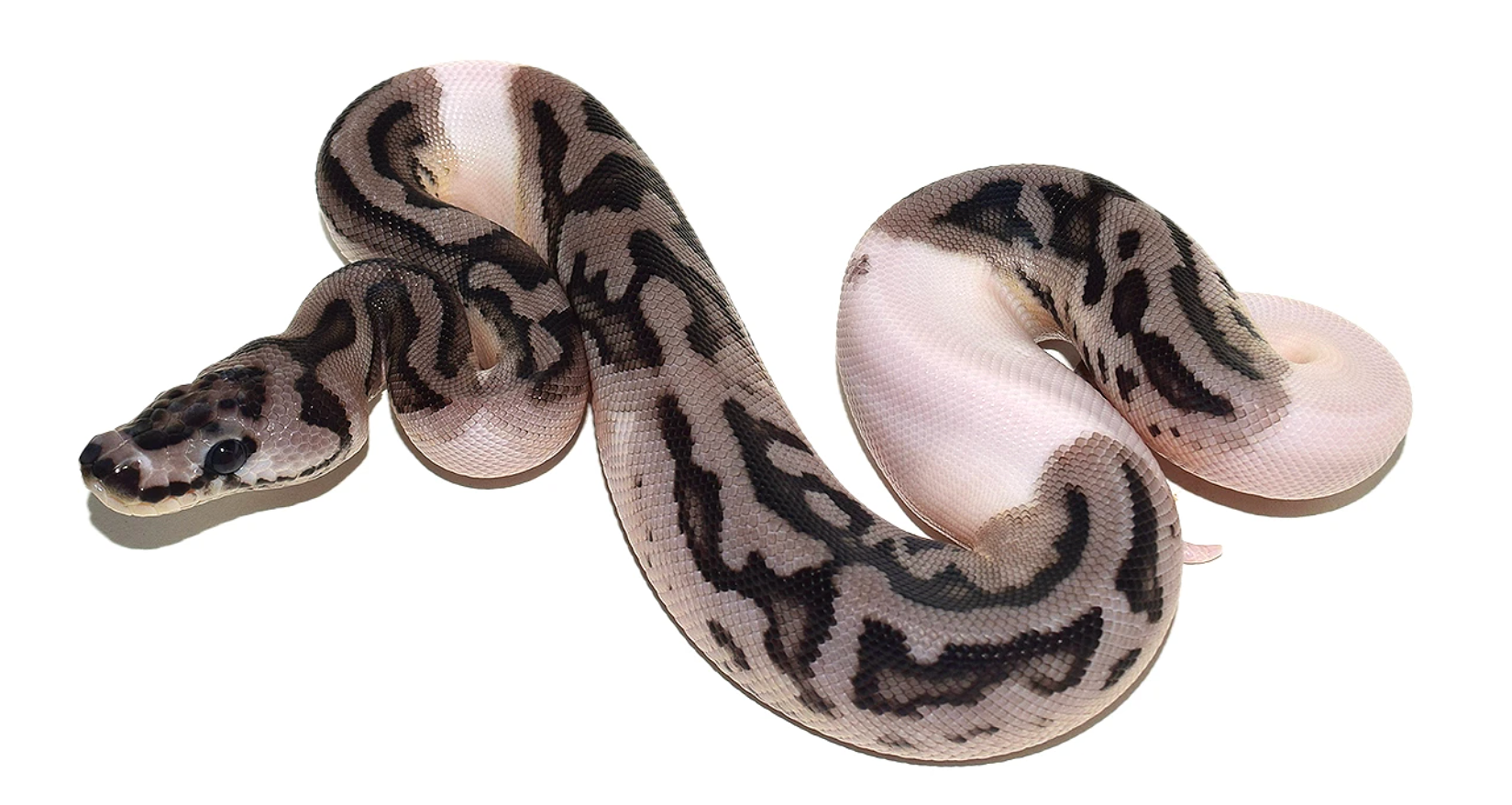
VPI Axanthic Clown Pied Het DG, by kinova
-
Axanthic expression has been linked to a loss-of-function mutation in the gch2 gene, identified through whole-genome sequencing. This mutation introduces a premature stop codon, producing a truncated, non-functional enzyme and disrupting the pterin biosynthesis pathway in xanthophores. As a result, yellow and red pigmentation is eliminated while melanin-based patterning remains intact.
-
Axanthic inheritance follows an autosomal recessive pattern, where the phenotype is expressed only in individuals homozygous for a loss-of-function allele.
-
Distinct axanthic lineages, including TSK, VPI, Joliff, and MJ, are genetically non-allelic, reflecting independent mutations that fail to complement in trans, thereby yielding a wild-type phenotype.
-
Axanthic expression reflects pathway-specific gene action, where disruption of xanthophore-derived pigments occurs independently of intact melanophore patterning.
-
In axanthic individuals, ontogenetic color change is characterized by a progressive “browning out,” likely reflecting age-dependent shifts in pigment composition and stability following disruption of pterin biosynthesis, consistent with broader evidence that colour expression in pythons is developmentally regulated across life stages in response to changing physiological and ecological demands.
-
Axanthic expression follows autosomal recessive inheritance, with visual expression occurring only in homozygous individuals. Expected genotype distributions from common pairings are as follows:
• aa × aa → 100% aa (visual)
• aa × Aa → 50% aa (visual), 50% Aa (heterozygous)
• aa × AA → 100% Aa (heterozygous)
• Aa × Aa → 25% aa, 50% Aa, 25% AA
• Aa × AA → 50% Aa, 50% AA
Among phenotypically wild-type offspring from an Aa × Aa pairing, the conditional probability of heterozygosity is 2/3.