THE BANANA BLUEPRINT
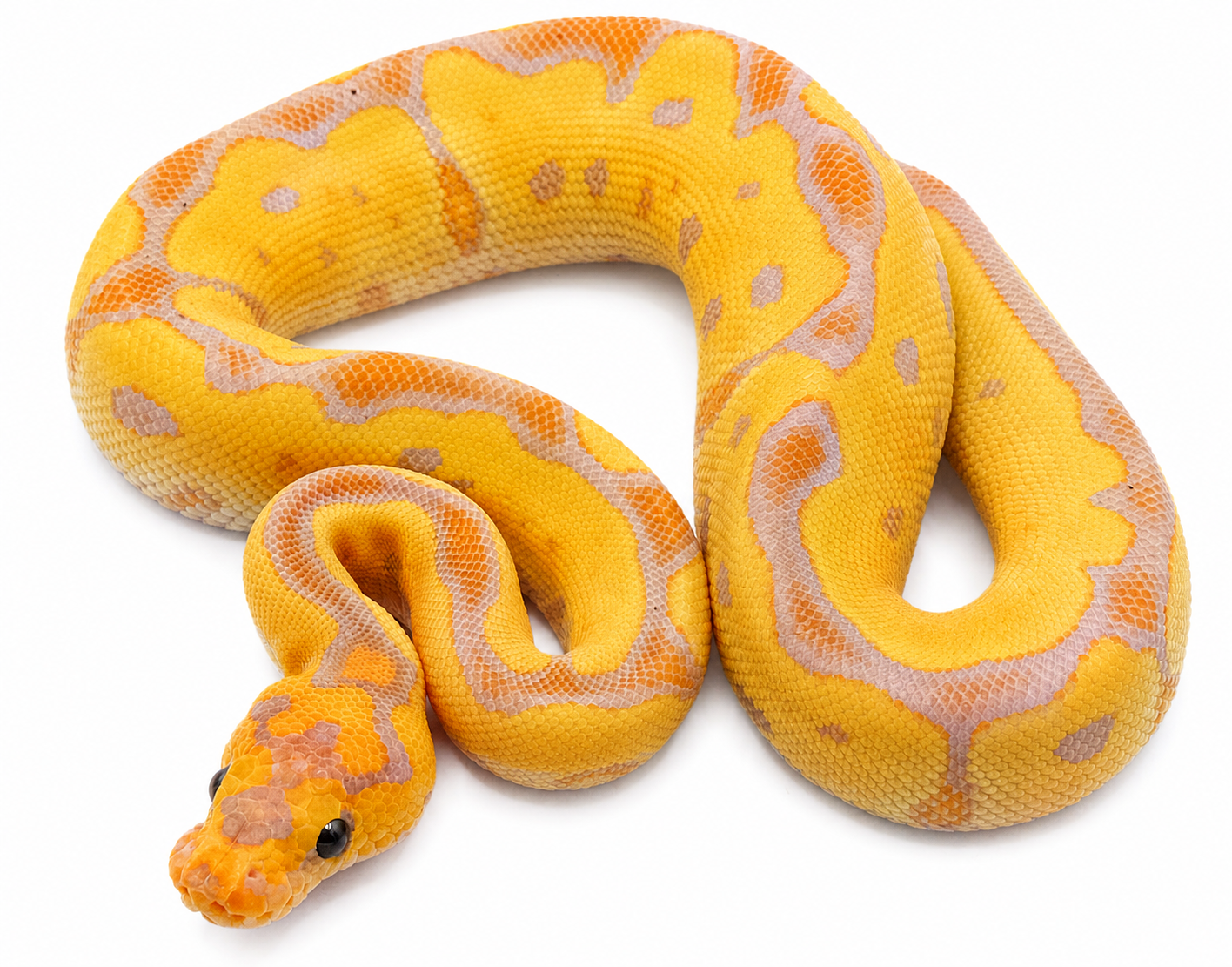
Nr Mandarin Banana Clown Het Pied, By Showcase Serpents
-
The molecular basis of the Banana phenotype has not been definitively characterized; however, phenotypic expression is consistent with a mutation affecting pigment distribution and chromatophore regulation. The characteristic yellow–lavender coloration and progressive freckling suggest altered melanin dynamics rather than disruption of a discrete pigment biosynthesis pathway.
-
Banana exhibits an incompletely dominant pattern of inheritance, where a single copy of the allele is sufficient for phenotypic expression and homozygous individuals display an intensified “super” phenotype. In addition, inheritance is influenced by sex-linkage, with transmission patterns dependent on the chromosomal origin of the allele.
-
The Banana allele demonstrates sex-linked inheritance, likely associated with the X chromosome, resulting in lineage-dependent transmission patterns. Males derived from female carriers (“female makers”) preferentially produce female Banana offspring, whereas males derived from male carriers (“male makers”) predominantly produce male Banana offspring, reflecting asymmetrical segregation across sex chromosomes.
-
Banana expression modifies underlying pigmentation without masking pattern formation, interacting additively with other loci to produce a wide range of composite phenotypes. The mutation alters pigment intensity and hue while preserving structural patterning, allowing downstream genes to remain visually expressed within the modified color framework.
-
Banana individuals exhibit progressive, age-dependent changes in pigmentation characterized by increasing freckling and localized melanin deposition. This ontogenetic shift reflects dynamic regulation of melanophore activity over time, producing variable spotting patterns that range from isolated scales to clustered pigmentation.
-
Banana expression follows incomplete dominance with additional sex-linked inheritance, resulting in genotype distributions that vary depending on parental genotype and the chromosomal origin of the allele. Expected outcomes from common pairings are as follows:
• Bb × bb → 50% Bb (Banana), 50% bb (non-Banana)
• Bb × Bb → 25% BB (super), 50% Bb (Banana), 25% bb (non-Banana)
• BB × bb → 100% Bb (Banana)
In addition to these Mendelian expectations, sex-linked transmission produces lineage-dependent deviations in offspring sex ratios:
• Male Banana (male-maker) × normal female → ~50% Banana males, ~50% non-Banana females
• Male Banana (female-maker) × normal female → ~50% Banana females, ~50% non-Banana males
• Banana female × normal male → ~50% Banana (mixed sex), ~50% non-Banana (mixed sex)
Among Banana offspring produced from sex-linked pairings, the expected sex distribution is influenced by the parental origin of the allele, resulting in skewed ratios characteristic of lineage-dependent transmission.