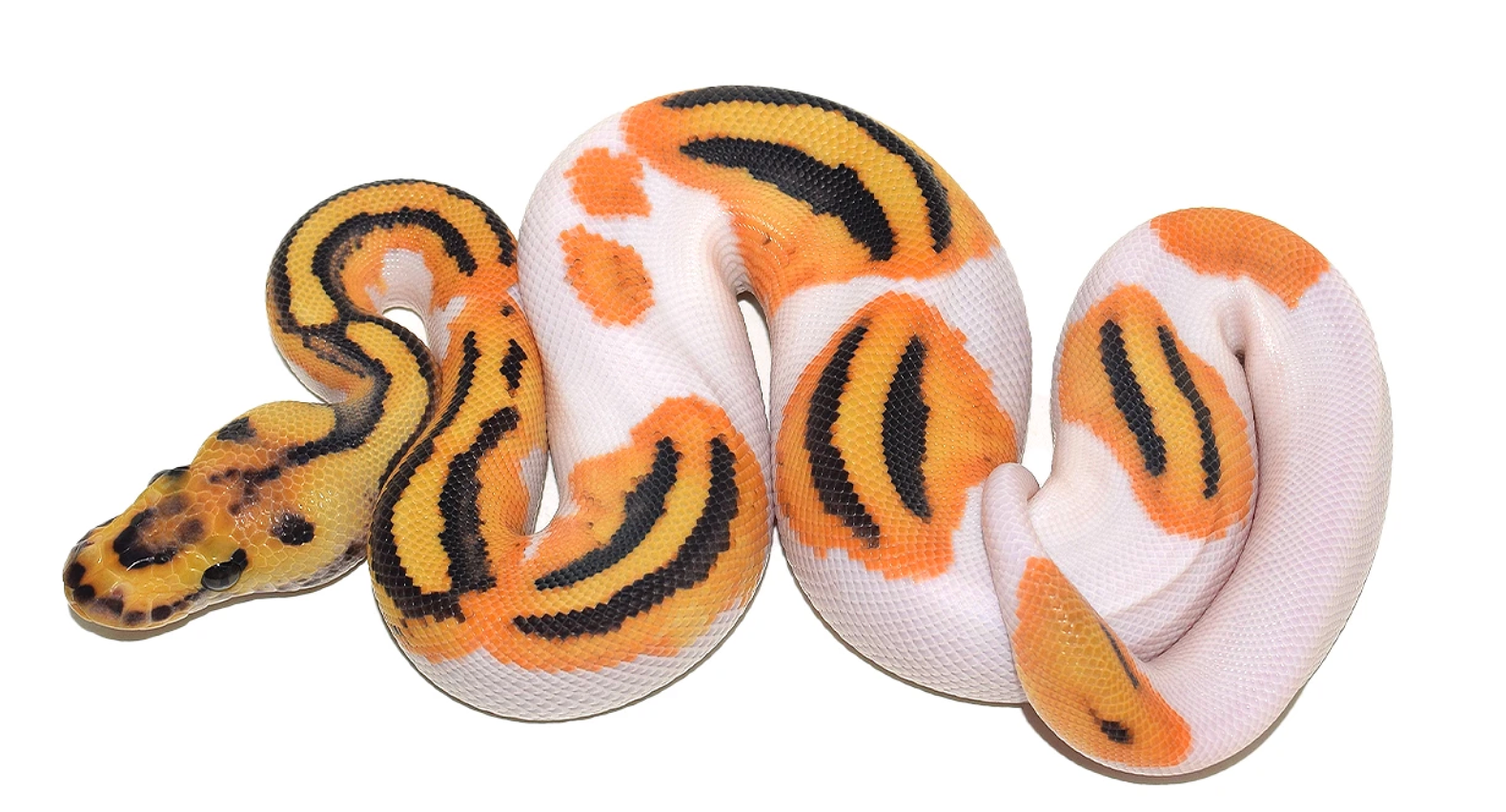
THE PIEBALD BLUEPRINT
YB DG Clown Pied Dbl Het Hypo G-Stripe, BY KINOVA
-
Piebald expression is caused by a recessive mutation in the tfec gene, which encodes a transcription factor within the MITF family involved in chromatophore development. A nonsense mutation introduces a premature stop codon, producing a truncated protein that disrupts normal regulation of pigment cell differentiation. Functional studies demonstrate that disruption of tfec impairs chromatophore development, leading to localized absence of pigmentation and the characteristic white patching observed in piebald individuals.
-
Piebald follows autosomal recessive inheritance, with phenotypic expression occurring only in individuals homozygous for the mutant tfec allele. Heterozygous carriers are phenotypically indistinguishable from wild-type individuals, necessitating genetic or breeding-based identification.
-
Current evidence supports piebald as a single-locus trait arising from mutation in tfec, with no established non-allelic line variation. Phenotypic differences in pattern distribution are instead attributable to variation in gene expression rather than distinct genetic loci.
-
Piebald expression represents a pattern-level disruption of chromatophore development, resulting in spatially restricted absence of pigment cells. Because pigmentation in reptiles arises from interactions among melanophores, xanthophores, and iridophores, loss of these cells in affected regions effectively masks the expression of other color genes while preserving their expression in pigmented areas.
-
Piebald patterning is developmentally established through early disruption of chromatophore differentiation and remains largely stable across ontogeny. However, variation in tfec expression levels contributes to a spectrum of phenotypes, ranging from low-white to high-white individuals, reflecting differences in the extent of pigment cell loss.
-
Piebald expression follows autosomal recessive inheritance, meaning visual expression requires two copies of the mutant tfec allele. Expected outcomes from common pairings are as follows:
• pp × pp → 100% pp (Piebald)
• pp × Pp → 50% pp (Piebald), 50% Pp (Het Piebald)
• pp × PP → 100% Pp (Het Piebald)
• Pp × Pp → 25% pp (Piebald), 50% Pp (Het Piebald), 25% PP (wild-type / non-carrier)
• Pp × PP → 50% Pp (Het Piebald), 50% PP (wild-type / non-carrier)
Among phenotypically wild-type offspring from a Pp × Pp pairing, the conditional probability of being heterozygous is 2/3, producing the breeder classification of 66% possible het Piebald.
In multi-locus pairings, piebald probability follows independent assortment, so the chance of producing a visual pied combination is calculated by multiplying the probability of homozygosity at the pied locus with the probability of the additional target trait.